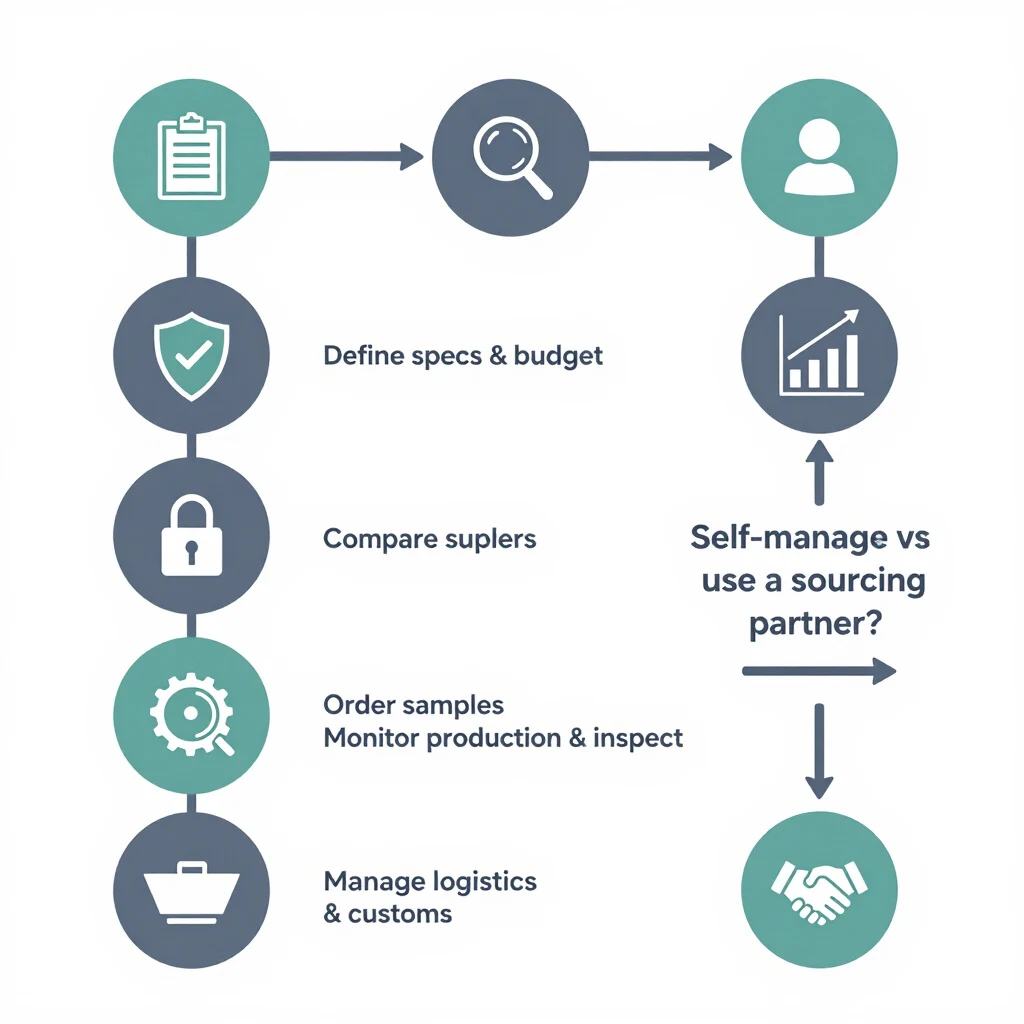
You have a product idea, a target price, and a launch date. Sourcing from China can cut costs, but you have also read about counterfeit suppliers, failed quality, and delayed cargo. You may be wondering what changed in 2026. This guide does not pretend to know every new rule or shortcut. Instead, it walks through due diligence you can apply before any money leaves your account.
Define your Define your Define your specifications and sourcing budget before you start
Most sourcing problems start with a vague request. If you cannot describe the product precisely, you cannot compare quotes, approve samples, or inspect production reliably. Write down every requirement that matters: materials, dimensions, color, function, packaging, labeling, and quality standards. Add tolerances for anything that can vary, like weight or thickness. If you are not sure about a specification, say so and ask the supplier for a recommendation. Do not let them decide everything.
Decide whether you need OEM custom manufacturing or ODM existing designs. OEM means the factory builds to your own drawings and specifications. ODM means they adapt an existing product they already make. OEM gives you more control but requires more detailed documentation and usually higher tooling costs. ODM is faster and less expensive, but the product can end up looking close to what your competitors already sell.
Set your budget with buffers. You will need money for samples, freight, inspection, duties, and last minute changes. A common mistake is budgeting only for unit price and then getting blindsided by tooling fees or minimum order quantity (MOQ). If you are new to importing, read up on Chinese procurement basics before you start.
Find candidate suppliers through your own network and SupplierAlly
Suppliers show up through B2B platforms, trade directories, industry referrals, trade shows, or a sourcing partner. Each channel has tradeoffs. B2B options return a long list, but many entries are trading companies rather than factories. Trade shows let you see product in person, but they are expensive and time consuming. Referrals from people in your industry can be reliable, but you still need to verify every name.
Set your screening criteria before you browse. Product category, factory type, location, certifications, communication speed, and MOQ are practical places to start. If you need a factory that handles small batches, filter for that early. If you need certifications like CE or FCC, ask for them from the first conversation.
Ask every candidate for business registration, factory address, product range, and customer references. Guard against evasiveness. If you want to narrow the field faster, a service such as SupplierAlly services can match your requirements and cut out obvious mismatches.
Verify every supplier before you pay
Verification is not optional in 2026. Confirm that the company you send funds to is who they claim to be and that they are able to produce the product. In China, ask to see the business license and cross-check the legal name and address through official records, but expect that some nodes require local help.
Request certification documents. If a supplier claims ISO 9001 or a product specific certificate, ask for the certificate number and check with the issuing body. If you cannot verify it, arrange an independent audit.
An on the ground check is standard practice. If you cannot visit, use a third-party inspection company or a sourcing partner local to China. They can confirm the factory exists, look at equipment, and evaluate working conditions. For a large or first order, this matters even more. SupplierAlly includes supplier verification services with physical checks and document review.
Find out whether the supplier is the legal manufacturer or only the trading agent. Also ask what export documents they can provide: commercial entry, packing list, and certificate origin. If they do not have them, customs delay is a real possibility.
Request comparable quotes and question every price
Send the same detailed spec sheet to multiple suppliers. Different specifications produce different prices and the numbers are impossible to compare. Include target quantity, packaging requirements, and the certification level you need. Ask for line by line break down: unit price, tooling cost, packaging, MOQ, lead time, payment terms, and Incoterms.
Incoterms are standard trade terms used in international contracts. Before you rely on one, confirm the exact meaning with official trade guidance. The Incoterm you pick changes who pays for freight, insurance, and customs, so you must know the obvious and hidden responsibilities.
Question any price that looks too good. Ask the supplier to explain the number. If they can’t, do not move forward. Ask about payment terms and treat full payment up front as a red flag.
If you need help comparing quotes, negotiation support from quotation and negotiation support can help sharpen terms without blowing the supplier relationship.
Protect your intellectual property before production
Think about intellectual property before you share product drawings, trademarks, or proprietary specs. This section is not legal advice. Talk to an IP lawyer who knows your home market and China. They can suggest patents, trademark registrations, and design registration as your situation requires.
Use non-disclosure agreements with your suppliers, but know that a paper is only as strong as your ability to enforce it. Share the minimum first. Watermark your drawings and send partial specifications when possible. For example, start with overall dimensions and only release the internal mechanism after the supplier signs for an allowed contract.
ODM suppliers usually make similar goods already. Ask them to confirm that your requested product does not infringe existing patents. That is a common area of risk and a responsible supplier will help you check.
Order samples and approve pre-production units
Do not skip the sample stage. A sample is your first physical proof that the supplier can actually build what you described. Order samples before bulk production starts. For custom products, plan on multiple rounds: a prototype to test the overall design, then a pre-production sample made with the same process as the final factory run.
Write acceptance criteria that cover material, dimensions, function, surface finish, and packaging. When the sample arrives, test it against that document. Do not just look at it. Use it, measure it, and ask a second person to test each thing you cannot judge yourself.
Make approval formal. Confirm it in writing and keep a reference sample alongside your file. If the factory changes anything later, you have a baseline to compare against in inspections.
If you are juggling multiple suppliers, sample coordination can reduce mistakes and save the back and forth.
is not your friend.
Monitor production and schedule quality inspections
Once the bulk order is in production, do not sit back and wait for the shipment to arrive. Place inspection checkpoints for raw materials, during production, and pre-shipment. Raw material runs confirm the right inputs are used. In process checks catch defects before they become a whole batch, and final inspection catches any problem that remains before the goods leave. each step has a different purpose.
You can hire a third-party inspection company or use a supplier with a proper local quality team. The inspection helps you compare products against your specs and the approved sample. Check packaging, label, and qty as well. Ask for full report with photos and measurement data.
Request weekly photo or video updates when you are not present. In a short order, a one week gap can be a month. Deep delays that surface later.
Define correction actions: if defects appear, does the factory rework, scrap, or replace? Who pays oversize shipping? Write the answer into the contract before the first batch is built. If you use a sourcing partner, production monitoring and quality inspection can handle that on your side.
Manage logistics, Incoterms, and customs counseling
Logistics is where first-time importers often lose the most. Pick Incoterms with full knowledge and verify the meaning with official international guidance before you commit. Know who is responsible for freight, insurance, and customs fees at each move. Look for extra charges that are not printed on the price.
Don’t rely on the draft of the forwarder. List the documents you need: commercial invoice, packing list, bill of lading, certificate of origin, and possibly others. Some goods need external certificates, such as phyto for wood products, CE declaration for electronic products, or chemical compliance for materials. Requirements change, so check current rules with official customs authority before final booking.
Compare shipping modes, consolidation options, warehousing, and last-mile costs. If the shipment is small, consolidating might be the smart part. If you sell online, think about local holding stock for returns and delivery speed.
Custom rules update often. Confirm with a customs broker or the government site for your destination before you send goods. A service such as logistics coordination can take care of freight booking, docs, and customs clearance on top of your other work.
Know when to self-manage vs use a sourcing partner
Do it yourself only if you have repeated experience, local language and contacts, the time needed, and a product that is not complex. If this is not your first and you already trust the factory, self-manage and keep the agency fee to yourself. For a first order or if the product leaves design to change, bringing a specialist to use is worthwhile.
A buying company can perform search, verification, price negotiation, sample handling, quality control, repacking, and delivery. They act as a local inspector and do not give you a bad error. The real question is whether the fee is less than one large mistake.
SupplierAlly uses one team across the entire process. You do not need to coordinate several layers; one team follows the project from supplier search to final delivery. That fits if you have multiple products or scale the products planned. If you want to check how the model works, read more about SupplierAlly.
Turn the checklist into an action plan
You now have the sequence: define specs, find suppliers, verify them, compare quotes, think through IP, approve samples, watch production, and inspect goods before they ship. The checklist below is a starting point, not a form to print quickly. Work through every line, even when a supplier pushes you to place an order faster.
If that feels too heavy and you don’t have the time, hand the entire chain to someone who does it every day. SupplierAlly can move your requirements through the same due-diligence chain and return a verified supplier, negotiated quote, inspected sample, recommended inspection schedule, and a logistics plan. Ask for a quote via request a quote, talk with a human at contact SupplierAlly, or look for more practical details in the SupplierAlly blog.
Practical checklist: pre-order due diligence
Print this page if that’s useful, write in your numbers, and keep it for your own record. Every section is a decision you can make before the first order.
| Area | Due Diligence checklist |
|---|---|
| Especificaciones del producto | Written spec sheet with materials, dimensions, tolerances, packaging, and quality standards |
| Verificación de proveedores | Business license, factory address, certifications verified, legal manufacturer confirmed |
| Quote comparison | Same spec sent to multiple suppliers, breakdown of unit price, tooling, MOQ, lead time, Incoterms |
| Protección de la propiedad intelectual | NDA signed, patents/trademarks filed, documents watermarked, partial specs shared |
| Aprobación de muestra | Sample received, tested against criteria, approved in writing, reference sample retained |
| Inspection milestones | Raw material, during production, pre-shipment inspections scheduled |
| Logistics and customs | Incoterms chosen, documents confirmed with forwarder, customs requirements verified |
Rules and regulations around importing can change quickly and without notice. Check current requirements with the right customs or trade authority before you commit. Discipline on this list is how you protect a solid sourcing relationship.
 ES
ES  EN
EN