Introduction: why the sourcing decision matters in 2026
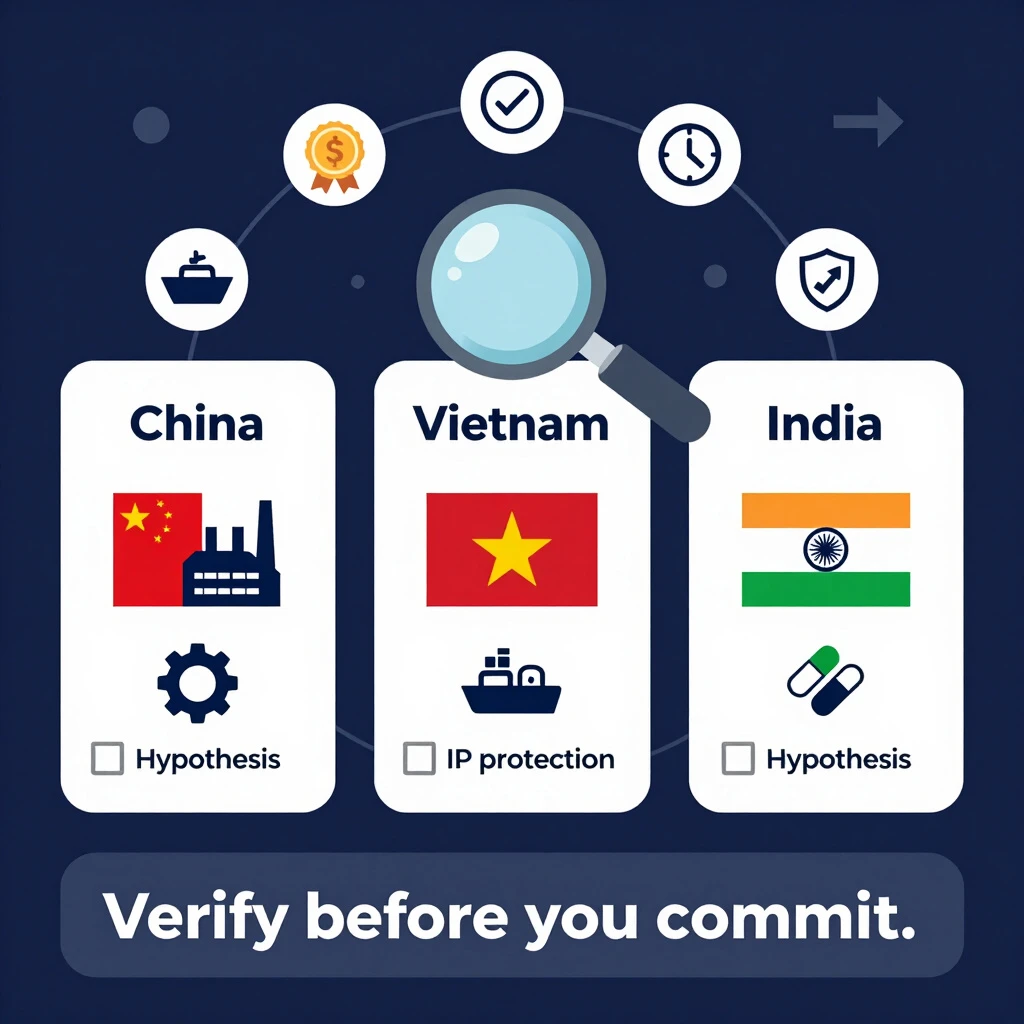
If you are a small business owner or product designer planning production for 2026, China, Vietnam, and India are probably the three names on your shortlist. The difficult part is separating useful comparisons from sales talk.
No independently verified 2026 statistics are used in this comparison, so every country-specific statement is labeled as a hypothesis. Treat the profiles as a starting point for your own research, not as a final answer. The goal is to help you make a more informed decision, not to steer you toward one country.
How to compare manufacturing countries: the criteria that matter
Before looking at any country, set the criteria you will use to judge it. These nine factors cover most sourcing decisions:
- Production cost: labor, materials, overhead, and hidden fees.
- Quality control: how consistent and reliable the output is.
- Lead time: from order to delivery, including production and shipping.
- Logistics and shipping: port access, customs, and freight options.
- Intellectual property protection: how well your designs and patents are safeguarded.
- Cumplimiento normativo: labor laws, environmental rules, and product standards.
- Communication and language: how easy it is to work with suppliers.
- Scalability: whether the supplier can grow with your order volumes.
- Supplier maturity: experience, certifications, and financial stability.
No single criterion is universally most important. A low-cost product with simple assembly might make production cost the priority. A complex electronic device might make IP protection and supplier maturity the priority. Rank these criteria based on your product and business goals.
Because no verified 2026 data is included, this comparison does not give specific numbers for labor costs, tariffs, or lead times. Those figures change with product category, volume, and supplier. The country profiles below are hypotheses. Verify current conditions with suppliers, industry contacts, and your own research.
China: a hypothetical profile
Treat this as a working hypothesis, not a verified profile for 2026. In that hypothesis, China has a deep supplier ecosystem. You can find suppliers for many components, materials, and finished products in one region. Prototyping may be faster, and logistics networks are often well established. The profile also assumes that large-scale production and complex parts are strengths.
Potential drawbacks in the same hypothesis include labor and material costs that may be higher than some competing locations, intellectual property risks unless contracts are carefully written, and the need for strong supplier due diligence. Trade policy and tariffs can change, so research the current tariff situation separately.
China is worth evaluating if your product needs scale or complex components. Confirm current quotes, lead times, and compliance requirements directly with suppliers before committing.
Vietnam: a hypothetical profile
Vietnam’s profile is also a hypothesis, not a verified 2026 picture. It assumes competitive labor costs and infrastructure that is still developing. The profile mentions a growing electronics and textile sector, but this comparison does not verify that description. A practical advantage in this hypothesis is proximity to China: you can source components in China and assemble in Vietnam, or reverse the flow.
Drawbacks include a less mature supplier ecosystem in some categories, possible infrastructure bottlenecks such as port congestion, and the need to verify that total costs are actually lower after logistics and tariffs.
If your product is moderately complex and cost is a priority, Vietnam is worth evaluating. Verify current supplier capabilities with factory audits and product samples.
India: a hypothetical profile
India’s profile is the same kind of working hypothesis. It includes a large workforce, a growing manufacturing base, and strengths in engineering, pharmaceuticals, and automotive components. The profile also includes access to a large domestic market, which matters if you plan to sell in India.
On the negative side, the profile lists infrastructure gaps, bureaucratic complexity, and wide variation in supplier quality. Any of these points may or may not apply to a specific supplier or region.
India is worth evaluating if your product is engineering-intensive or intended for the Indian market. Check each claim with current data and direct supplier communication.
Side-by-side comparison: a hypothetical framework
The table below is a hypothetical example. It is not sourced or verified and should not be treated as a rating of any country in 2026.
| Criterios | Porcelana | Vietnam | India |
|---|---|---|---|
| Production cost | Hypothesis: medium | Hypothesis: low to medium | Hypothesis: medium |
| Control de calidad | Hypothesis: high (varies by supplier) | Hypothesis: medium to high | Hypothesis: medium |
| Plazo de entrega | Hypothesis: short | Hypothesis: medium | Hypothesis: medium to long |
| Logística | Hypothesis: strong | Hypothesis: good | Hypothesis: fair |
| Protección de la propiedad intelectual | Hypothesis: medium (requires contracts) | Hypothesis: medium | Hypothesis: varies by supplier |
| Cumplimiento | Hypothesis: varies by supplier | Hypothesis: varies by supplier | Hypothesis: varies by supplier |
| Comunicación | Hypothesis: good (English varies) | Hypothesis: good | Hypothesis: good (English varies) |
| Escalabilidad | Hypothesis: strong | Hypothesis: good | Hypothesis: good |
| Supplier maturity | Hypothesis: high | Hypothesis: medium to high | Hypothesis: medium |
These ratings are hypothetical examples, not verified data. Use them to see which countries align with your priorities, then replace them with your own research and supplier quotes.
How to choose the right country for your product
Apply the framework in this order.
- Define your product requirements. Write down the complexity, target volume, quality standards, and IP sensitivity. A simple plastic part is different from a circuit board with proprietary firmware.
- Rank the criteria. Decide which factors matter most to your business. If you are launching a low-cost product, cost might be your top priority. If you are building a premium brand, quality and IP protection might matter more.
- Shortlist countries. Based on your rankings, eliminate countries that clearly do not fit. Under the hypothetical profiles above, China might be a first choice if you need very high volume and a mature supply chain. Vietnam could be a better fit if you need lower costs and moderate complexity. Use these as working assumptions, not verified facts.
- Research suppliers. Use online directories, trade shows, and industry contacts. Look for companies with experience in your product category.
- Request quotes and samples. Contact several suppliers in each country. Ask for detailed quotes that include tooling, unit price, MOQ, lead time, and payment terms. Order samples and test them thoroughly.
- Verify before committing. Do not rely on a supplier’s word. Conduct a factory audit, check certifications, and consider a third-party inspection. If you do not have the time or expertise, consider working with a sourcing partner.
The process is not quick, but it is necessary. The cost of a wrong decision, a factory that cannot deliver, poor quality, or IP theft, far outweighs the time you spend on due diligence.
The role of a sourcing partner in verifying your choice
Comparing suppliers across three countries takes time. If you want help with the steps above, you can work with a sourcing partner. SupplierAlly offers supplier search and verification services, quotation and negotiation support, sample coordination, production monitoring, quality inspection, repackaging, and logistics coordination.
That list is simply what the service includes. Nothing in this comparison claims that using it produces a specific result. To explore the options, you can request a sourcing quote o contact the SupplierAlly team.
Practical checklist: questions to ask before you commit
Use this checklist when evaluating any supplier, regardless of country. Write down the answers and compare them across candidates.
- Factory audit: Have you visited the factory? Are they willing to host an audit? What certifications do they hold, such as ISO or BSCI?
- Sample testing: Did you receive samples? Did they meet your specifications? How many rounds of samples were needed?
- MOQ flexibility: What is the minimum order quantity? Can they handle smaller initial orders?
- Lead time: What is the production lead time? What is the shipping time? Are there any known bottlenecks?
- Payment terms: What payment terms do they offer, such as a deposit with the balance before shipment? Are they open to letters of credit?
- Communication: How responsive are they? Do they speak your language? Do they provide regular updates?
- IP protection: Are they willing to sign a non-disclosure agreement? Do they have experience protecting client designs?
- Compliance: Do they follow local labor and environmental laws? Can they provide documentation?
- Contingency plans: What happens if there is a delay or a quality issue? Do they have backup suppliers?
This checklist is generic, but it can help you uncover red flags early. If a supplier is vague or unwilling to answer, that is a warning sign.
Conclusion: making the decision with confidence
There is no single best country for manufacturing in 2026. The right choice depends on your product, volume, budget, and risk tolerance. The profiles in this guide are hypotheses. China, Vietnam, and India each have potential trade-offs, but those trade-offs must be verified with current quotes, samples, supplier audits, and your own research.
Do not finalize a country and factory based on this comparison alone. If you want help with supplier search, verification, or the other sourcing steps, you can request a sourcing quote from SupplierAlly.
For procurement basics, see the Chinese procurement basics guide. For more sourcing topics, browse more sourcing guides on the blog.
 ES
ES  EN
EN