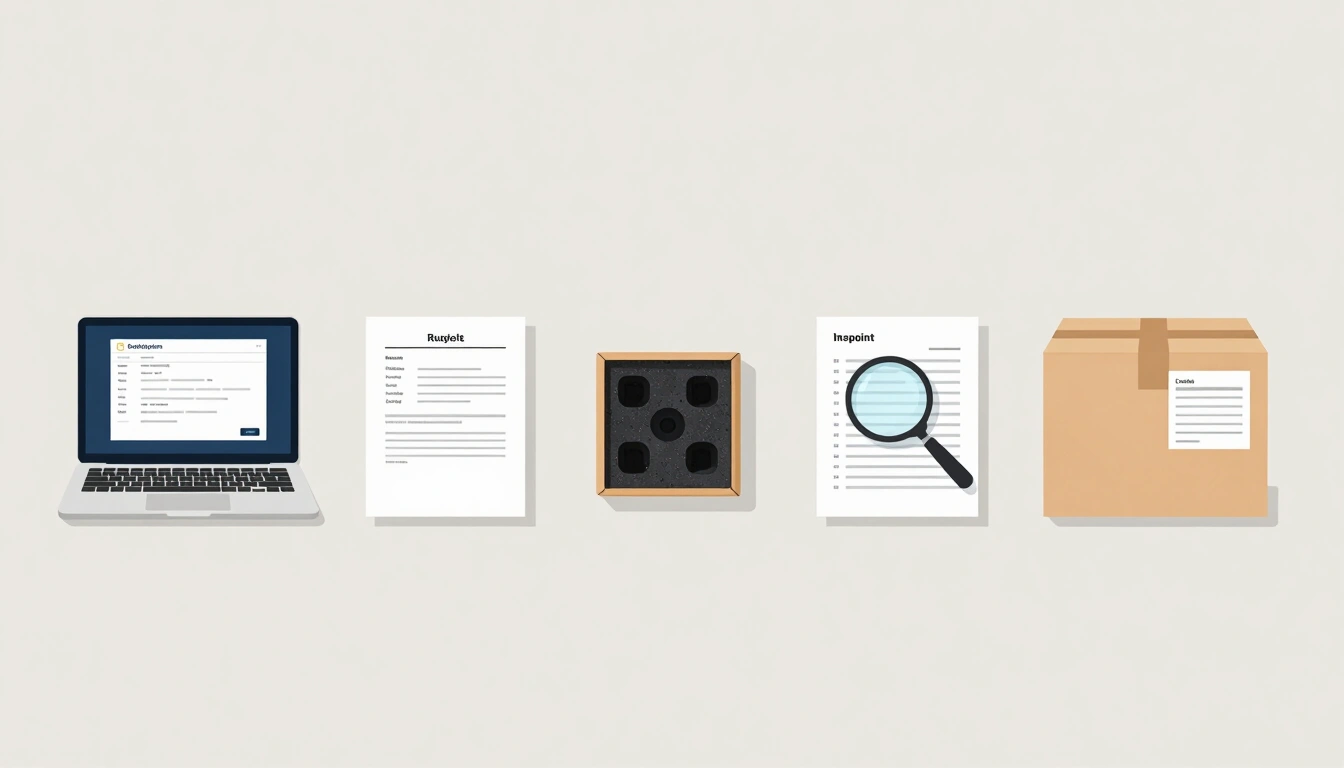
You can buy premium products from China without boarding a plane, but only if you stop treating trust as something you feel and start treating it as something you verify. The buyers who get burned are rarely the ones who skipped a factory visit. They are the ones who skipped a document check, approved a sample they never tested, or paid in full before a single inspection happened. Every step below replaces a physical handshake with a written record, and that record is what protects you.
1. Verify the supplier before you ask for a price
Anyone can put up a website with a factory photo. Verification starts with the legal identity of the company you are actually dealing with. Ask for the business license, which in China is issued by the local Administration for Market Regulation and carries a unified social credit code. Cross-check that code against the National Enterprise Credit Information Publicity System, the official registry run by the State Administration for Market Regulation. A supplier that hesitates to share its license, or whose registered name does not match the name on your quotation, is a reason to walk away before you spend a dollar.
Then check what the company actually does. A trading company and a manufacturer are different animals, and neither is automatically bad. A trading company can be a fine partner for a small order because it consolidates multiple factories and handles export paperwork. A manufacturer gives you direct control over production and usually better unit pricing at volume. The risk is that a middleman presents itself as a factory to justify a markup. Ask for the factory’s license, its address, and a live video walkthrough of the production floor. If the address on the license does not match the address on the video, you have your answer.
2. What a complete quotation should contain
A one-line price is not a quotation. It is a starting point that leaves room for every cost to appear later. A usable quotation names the product and its exact specification, the unit price, the currency, the Incoterm, the payment terms, the lead time, the minimum order quantity, and the packaging. If any of those fields is missing, ask for it in writing before you compare suppliers.
Here is a practical way to compare three suppliers side by side:
| Field to compare | Why it matters | What to watch for |
|---|---|---|
| Unit price and currency | Sets your landed cost baseline | Prices quoted in different currencies or with vague exchange assumptions |
| Incoterm | Defines who pays freight and who owns risk at each point | A low FOB price that hides ocean freight and insurance |
| Payment terms | Determines how much money you expose before goods ship | Demands for 100% upfront on a first order |
| Lead time | Tells you when you can actually sell | Optimistic dates with no buffer for inspection or customs |
| MOQ | Sets your cash commitment and inventory risk | An MOQ far above what you can sell in a reasonable window |
| Packaging | Affects freight cost and whether goods arrive intact | No mention of carton dimensions, weight, or export carton quality |
Get every quotation in the same format so you are comparing like for like. A supplier that refuses to put its terms in writing is telling you how the relationship will go.
3. The pre-production sample is the cheapest insurance you will buy
Never approve a production run from a photo. Order a pre-production sample, which is made from the same tooling and materials as the final run, and test it the way your customer will. If you sell a water bottle, fill it and check for leaks. If you sell a garment, wash it and check the seams. If you sell electronics, run them through the voltage and safety checks that apply in your market. A sample that looks right in a photo can fail in your hands, and it is far cheaper to learn that from one unit than from a thousand.
Here is a hypothetical example to make the point concrete. Imagine you are sourcing a stainless steel tumbler. The supplier sends a photo of a polished, logo-free sample and you approve it. When the production batch arrives, the logo is misaligned and the powder coating chips after a week of use. A pre-production sample with your logo applied, tested for coating adhesion and dishwasher cycles, would have caught both problems before you committed to the full quantity. That is the entire point of the step.
Keep the approved sample. It becomes your reference standard, and your inspector compares the production units against it, not against a description in an email.
4. Third-party inspection replaces the factory visit
You cannot stand on the line and watch your goods being made, so you hire someone who can. A third-party inspection company performs a pre-shipment inspection at the factory, typically checking quantity, appearance, dimensions, function, and packaging against your approved sample and specification. The inspector works to a checklist you approve in advance, and you decide the acceptable quality level, which is the number of defects you will tolerate in a batch. This is a decision you make, not something the inspector decides for you.
An inspection is not a guarantee that every unit is perfect. It is a statistical check that gives you a defensible reason to accept or reject a batch before it ships. The report comes back with photos and measurements, and you use it to release payment or to demand a rework. For many buyers this single step removes most of the fear that drives them to fly to China in the first place.
5. Payment terms carry real risk, so structure them
How you pay is a risk decision, not a convenience decision. On a first order, a supplier asking for 100% of the value before production is a red flag, because you have no leverage if the goods are late, wrong, or never made. A more common and safer structure is a deposit to start production, often around 30%, with the balance due after inspection and before shipment. The exact split is negotiable, and a supplier that has worked with international buyers will expect to negotiate it.
Wire transfer is the standard method, but it offers no buyer protection if something goes wrong. For larger orders, a letter of credit through your bank ties payment to documents that prove shipment, which shifts some risk to the bank. The tradeoff is cost and paperwork. For small first orders, many buyers accept the wire risk because the alternative is too expensive, and they manage it by keeping the deposit low and inspecting before the final payment. State your limits honestly: if you cannot afford to lose the deposit, you should not be sending it to an unverified supplier.
6. Incoterms decide who owns the risk at each step
Incoterms are the internationally recognized rules, published by the International Chamber of Commerce, that define who pays for freight and who bears risk at each point in the journey. The two you will see most often are EXW and FOB. Under EXW, or Ex Works, you collect the goods at the factory and own the risk from the moment they leave the door. Under FOB, or Free On Board, the supplier is responsible until the goods are loaded onto the ship, and risk passes to you at that point.
For a remote buyer, FOB is usually the more practical choice because it gives the supplier a reason to get the goods to the port and loaded. EXW pushes every logistics step onto you, which is fine if you have a freight forwarder handling it, but it means you are coordinating the pickup from a factory you have never visited. Whichever term you choose, put it in the quotation and understand that it changes your insurance obligations. The ICC publishes the full Incoterms rules, and your freight forwarder can walk you through the specific obligations for your route.
7. The documents that move your goods through customs
Your goods do not clear customs on good intentions. They clear on documents. The core set includes the commercial invoice, the packing list, and the bill of lading, which is the transport document issued by the carrier. Depending on your market and product, you may also need a certificate of origin, and for regulated goods such as food, cosmetics, or electronics, you may need additional compliance documentation from the relevant authority in your country.
In the United States, for example, the importer of record is responsible for the accuracy of the entry filed with U.S. Customs and Border Protection, and the Food and Drug Administration sets requirements for products it regulates. The practical point is that compliance is your responsibility, not the supplier’s. A supplier will happily ship you a product that your market will not let you sell. Before you commit to a product category, confirm what documentation your market requires, because that determines whether your remote sourcing plan is even viable.
8. When an agent is worth the cost, and when it is not
You can run this entire process yourself, and for a single product with a small order, you probably should. The tools are public, the documents are standard, and the inspection companies are easy to hire. The case for an agent is not that remote sourcing is impossible on your own. It is that an experienced agent compresses the learning curve, holds suppliers to the standards you set, and handles the coordination that eats your time.
An agent is most valuable when you are sourcing many products, when you need help finding and vetting suppliers in a category you do not know, or when you want someone on the ground to manage production and inspection across multiple factories. The cost is a fee or a markup, and you should understand exactly how the agent is paid so their incentives align with yours. An agent paid a percentage of the order has an incentive to close the order; an agent paid a flat fee for verification and coordination has an incentive to protect you. Neither is wrong, but know which one you are hiring.
You do not need an agent to buy a verified product from a verified supplier with a tested sample and a clean inspection report. You need an agent when the complexity of your sourcing exceeds the time you are willing to spend on it.
9. A scorecard for your remote sourcing decision
Before you release a production deposit, run the supplier through this checklist. If you cannot answer yes to most of it, slow down.
- Business license matches the quotation and checks out in the official registry
- Factory address is confirmed and matches the license
- Quotation includes unit price, Incoterm, payment terms, lead time, MOQ, and packaging
- Pre-production sample was tested against your real use case and approved
- Approved sample is kept as your reference standard
- Third-party inspection is scheduled before final payment
- Payment structure limits your exposure before inspection
- Incoterm is chosen and understood
- Import documents and market compliance are confirmed
This is not a guarantee of a perfect shipment. It is a way to make sure that when something does go wrong, you find out early, with leverage, and with a paper trail that tells you exactly who is responsible.
10. Your verification loop is the whole strategy
Remote sourcing works because every physical step has a documented replacement. You verify the company through the official registry, you compare complete quotations, you test a sample, you inspect the batch, you structure payment around the inspection, and you confirm the documents before you ship. Each step narrows the gap between what the supplier promises and what you actually receive.
The buyers who succeed at this are not the ones who trust the most. They are the ones who verify the most, and who treat every document, sample, and inspection report as part of a single chain of evidence. Build that chain once, and the next product you source from China is just a repeat of a process you already know works. If you want help building it, a sourcing partner can handle the verification, sampling, inspection, and logistics coordination for you.
 EN
EN  ES
ES