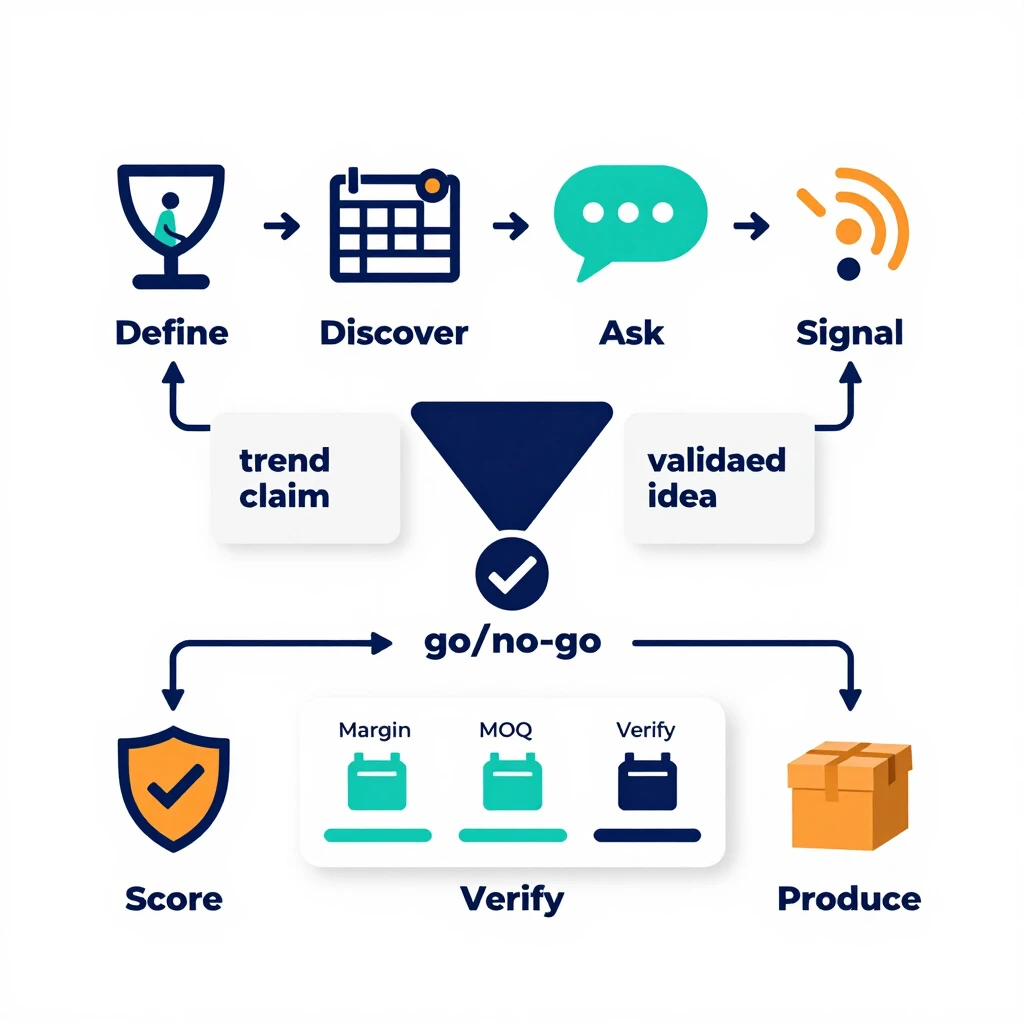
You want to find a product that will take off, and you think the factory floor in China might hold the answer. It can, but not the way most trend articles suggest. Scan their catalogs, ask about order patterns and repeated customizations, then validate the resulting ideas through samples, pre-orders, and small market tests before you commit to production. No method can guarantee that a product will go viral. The goal is a repeatable process that reduces risk and helps you move from idea to verified order with confidence.
1. Define your customer, budget, and product criteria before searching
Before you open a single B2B listing, write down who you are selling to, what price range makes sense, which categories you understand, and how much you can afford to lose on a bad bet. These filters keep you from chasing unrelated products. If you are new to direct sourcing, start with the China sourcing basics to understand the landscape, but do not let that background replace your own criteria.
Your criteria should include target customer, price range, category comfort, shipping and storage constraints, and your tolerance for minimum order quantities (MOQs). Treat every assumption as a hypothesis to test later, not as confirmed demand. For example, you might assume that a lightweight, portable gadget appeals to urban commuters, but you have no evidence yet. That is fine. The point is to have a filter so you do not waste time on products that do not fit your business model.
2. Scan manufacturer catalogs and B2B listings for repeated patterns
Look for variations, packaging changes, and new component options. A product that appears in slightly different forms across several suppliers might be getting updated for a reason. Track items that seem newly added or frequently updated. Keep a log of candidate products with the source supplier and the specific details you noticed. This log becomes your raw material for later conversations.
Catalog presence alone does not prove a product will go viral. Treat it as a starting point for investigation, not as a reason to order.
3. Ask suppliers directly what is moving in their workshops
When you contact a supplier, do not just ask for a price list. Ask which products have recently had rising order requests, faster reorder cycles, or new customizations. Ask about components and materials that buyers are requesting. A factory that makes phone cases might tell you that a specific texture or material is suddenly popular. That is a signal worth following.
Ask suppliers to suggest alternatives or upgraded versions of existing products. They know what can be modified without retooling. Compare answers across several manufacturers. Treat the resulting list as candidate ideas until you validate each one independently before ordering.
4. Spot momentum signals without mistaking them for proof
Supplier responses are directional, not guarantees. A factory might see repeat orders because a single dropshipper is testing a product, not because the market is exploding.
Use these signals to rank your list. Which ideas have the most convergence across suppliers? Which have the most specific customization requests? Those are the ones worth spending time and money on validation. Never skip validation because a supplier said something is hot.
5. Validate the product idea before you talk about bulk orders
Start by defining a demand hypothesis: who is the customer, what problem does the product solve, and at what price would they buy it? Then run low-cost tests. Order a sample and test it yourself. Create a pre-sale page and see if people click or buy. Interview a few potential customers. Run a small ad campaign to gauge interest. Use marketplace keyword research to see if people are searching for the product.
Set go/no-go thresholds before you test. For example, a hypothetical threshold might be: if the pre-sale page gets at least 50 clicks and 5 pre-orders within a week, you proceed. These are hypothetical examples; your thresholds depend on your product and market. Also check saturation signals: how many similar listings exist, how many reviews competitors have, how aggressive the ad competition is, and whether prices are being driven down. If the market is already crowded and price-compressed, even a good product may not be worth the risk.
Proceed only when validation supports your hypothesis. If the tests are inconclusive, move on to the next idea.
6. Use a product-idea evaluation scorecard to compare options
Once you have several validated candidates, score them side by side. Use criteria that matter to your business: demand evidence, differentiation, price margin, MOQ fit, shipping complexity, supplier reliability, and competition. Rate each from low to high. The scores reflect your own research; they do not guarantee success.
Here is a hypothetical example with three fictional products to show how the scorecard works:
| Criteria | Product A (fictional) | Product B (fictional) | Product C (fictional) |
|---|---|---|---|
| Demand evidence | Medium | High | Low |
| Differentiation | Low | High | Medium |
| Price margin | High | Medium | Low |
| MOQ fit | Good | Fair | Poor |
| Shipping complexity | Low | Medium | High |
| Supplier reliability | Medium | High | Low |
| Competition | High | Medium | Low |
In this hypothetical, Product B scores best overall because it has high demand evidence, strong differentiation, and a reliable supplier, even though shipping is more complex. Use the scorecard to shortlist. The final decision always comes after you have spoken to the supplier and verified their capabilities.
7. Ask suppliers the right questions: outreach and negotiation template
When you have a shortlist, you need to turn it into a supplier conversation. Here is a hypothetical template you can adapt. Replace the placeholders with your own details.
Hypothetical example email:
Subject: Inquiry about [Product Description]: MOQ, Lead Time, and Sample
Dear [Supplier Name],
I am interested in [product description] and saw your listing on [platform]. I have a few questions before we proceed:
- What is the minimum order quantity (MOQ) for this product?
- What is the lead time for production after sample approval?
- Can you provide a sample? What is the sample cost and shipping fee?
- Do you offer customization (color, logo, packaging)? If so, what are the setup costs?
- What certifications or compliance documents do you have for this product?
- What are your payment terms?
- Can you provide a breakdown of packaging options and costs?
I am evaluating a few suppliers and would appreciate a detailed quote. Thank you for your time.
Best regards,
[Your Name]
During negotiation, ask about price breaks at higher volumes, sample adjustments, exclusivity, production capacity, and inspection options. If you need help with quotation and negotiation support, a sourcing partner can handle these conversations for you, but you should still understand the key terms.
8. Verify the supplier before sending money or committing to production
Verification is the layer that protects your investment. Request business registration, factory photos or video, third-party audit reports, references from other buyers, and product samples. Confirm the quality inspection process and how responsive the supplier is to your questions.
SupplierAlly provides personalized supplier search and verification, along with quotation and negotiation support, sample coordination, production monitoring, quality inspection, repackaging, and logistics coordination for international buyers. Verification is due diligence; it does not guarantee product success. Even a verified supplier can produce a product that fails in the market.
9. Move from sample approval to production and logistics
Once you have a verified supplier and an approved sample, you can move to production. Negotiate the final price, MOQ, lead time, payment terms, and penalties for late delivery before you sign anything. Approve the sample in writing, then monitor production. Schedule a quality inspection before shipment. Plan repackaging, labeling, and logistics with a freight forwarder or a sourcing partner. Keep all documentation and communication records.
A good sourcing partner can handle the coordination, but you still need to understand the process to make informed decisions.
10. Avoid common sourcing and validation mistakes
Skipping validation is a common mistake. So is trusting viral trend claims without your own evidence. Do not order large quantities before validation. The best you can do is reduce uncertainty and make informed bets.
11. Questions buyers ask about finding and validating products
How do I find viral product ideas directly from Chinese manufacturers? Use supplier discovery plus independent validation. Ask suppliers about order patterns, scan catalogs for repeated patterns, and then validate the ideas with samples and market tests.
What signals might indicate an emerging product trend? Repeat orders, faster restocks, and shared component requests are candidate signals, but they are not proof. They help you prioritize which ideas to validate.
How do I validate a product before large orders? Order samples, run pre-sale pages, interview customers, run small ad campaigns, and check marketplace keyword data. Set go/no-go thresholds before testing.
How can I tell if a product is saturated? Check listing volume, reviews, ad competition, and price compression in your target market. If many sellers are fighting for the same keywords and margins are thin, it may be saturated.
Can I request samples before bulk order? Yes, you can request samples.
How do I verify a manufacturer? Request business registration, third-party audits, references, and samples. Use a verification service if you need help.
12. Turn a validated idea into a reliable order
The process is: define criteria, discover from suppliers, identify signals, validate, evaluate, ask questions, verify, produce, and ship. No method can guarantee virality. Consider using a sourcing partner to handle the reliability layer. SupplierAlly offers personalized supplier search and verification, quotation and negotiation support, sample coordination, production monitoring, quality inspection, repackaging, and logistics coordination. If you have a validated idea and need help turning it into a confirmed order, request a quote or contact SupplierAlly. You can also browse success stories to see how other buyers have navigated the process, though every situation is unique.
For more practical guidance, check the SupplierAlly blog for ongoing sourcing insights.
 EN
EN  ES
ES