Picture this: you have been comparing export-ready suppliers for a product line, and a contact passes along a factory that does not show up on any export platform. The quoted unit price is lower than everything you have seen. The factory says it only sells domestically but “can arrange” the export side. You have one week to decide.
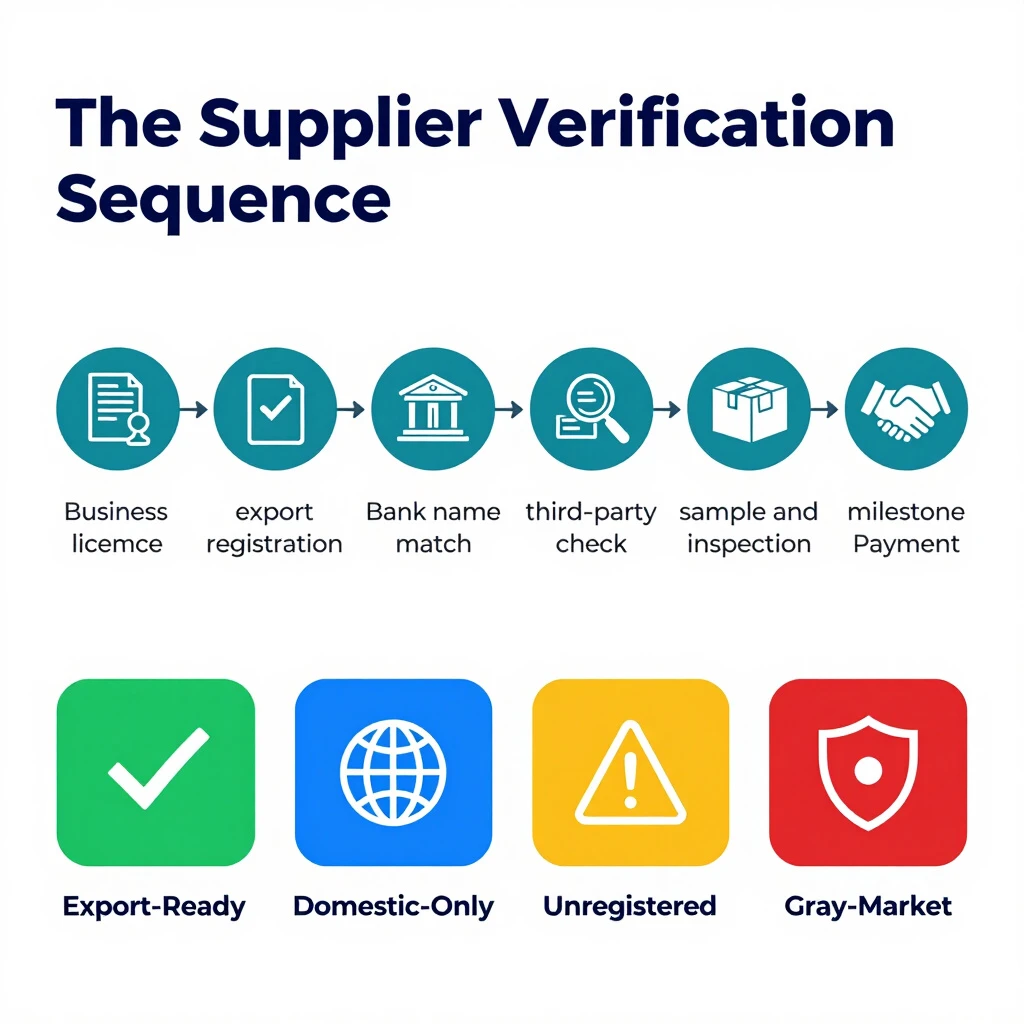
This situation, though hypothetical, follows a familiar shape. The phrase can describe several ordinary situations: a registered factory that sells only domestically, a workshop without verifiable registration, or goods sold outside authorized channels. None is a hidden category you unlock with a contact. A secret directory is beside the point. The useful question is whether you can verify the supplier. The real advantage comes from a verification sequence: confirm the business license, confirm export status, test samples, inspect production, and structure payment around verifiable milestones. Buyers who skip those steps carry customs, compliance, and quality risk that no price discount offsets.
What “underground wholesale supplier” actually means when you source from China
“Underground” is buyer shorthand, not a defined industry category. It describes suppliers that are hard to find through mainstream export channels: marketplaces, trade shows, and agent referrals. Why a factory is hard to find matters more than the fact that it is hard to find.
Three operational categories cover almost everything buyers mean. Domestic-only factories are registered companies selling inside China without export procedures. They are not hidden, just outside the export ecosystem. Unregistered workshops produce without a verifiable business license. A missing license does not automatically prove fraud, but it creates an unmanageable verification burden for a foreign buyer. Gray-market goods are made by registered factories then diverted outside authorized channels: overruns, seconds, or goods meant for one market sold in another. Manufacturing can be lawful while the sale may still create trademark, distribution-agreement, or customs risk in your market; that calls for legal review, not only document checks.
The practical question is whether the supplier can document production and export legally. Hidden or not is secondary. If you are new to China procurement, review the fundamentals of business licenses, export documents, and Incoterms before evaluating any hard-to-find factory.
Which supplier type fits your product, budget, and risk tolerance?
Each category has a different documentation profile and verification burden. The right choice depends on your product, order size, and how much risk you can absorb. Price alone is the wrong filter.
| Supplier type | What it is | Documentation status | Verification burden | Main risks |
|---|---|---|---|---|
| Export-ready factory | Registered company with export procedures in place | Business license plus export registration | Lowest; standard checks apply | Quality and delivery issues, not structural ones |
| Domestic-only factory | Registered company selling inside China | Business license; no export registration | Medium; export handling must be arranged | Customs clearance failures; wrong export packaging |
| Unregistered workshop | Production without verifiable registration | No reliable license to check | High; you cannot verify the entity | Scam risk; customs and compliance fall on you |
| Gray-market goods | Authorized goods diverted outside official channels | Factory documents exist but do not cover the sale | High; requires legal review | Intellectual property and customs seizure risk |
Treat this table as a decision framework, not a data source. Use it to compare documentation and verification burden, not as a measure of how common each category is. For most first-time and small-batch buyers, the export-ready factory is the sane default. The domestic-only factory becomes attractive with a distinct product, a genuine price advantage after export costs, or a volume too small for export-oriented factories to care about. Unregistered workshops and gray-market goods require legal review in addition to document checks.
Which documents should you request from a Chinese supplier?
The first document to request is the business license, often called 营业执照 (yingye zhizhao). What you are checking is consistency: the company name, registered address, legal representative, and business scope should line up with the company you are negotiating with. A license that lists only trading tells you to ask whether the company is a middleman. A scope that does not mention your product tells you to ask how it can produce or trade that product.
Next, ask how the company exports. If the supplier says it has exported, request the export-related customs registration and recent customs declarations or bills of lading under the company’s own name. A domestic-only factory may not have these. Close that gap before shipment; it does not by itself mean fraud.
These documents do not prove product quality, financial health, or whether your goods will pass safety, labeling, and certification requirements in your destination market. Verify those separately. Supplier paperwork does not cover them.
Treat this as operational guidance based on how sourcing transactions normally work, not as a legal opinion. Export requirements change, and product categories have their own rules. For legal questions, get review from a trade lawyer who knows Chinese and your destination-market rules. The vocabulary for these documents and Incoterms is covered in the China procurement fundamentals guide.
How to verify a Chinese supplier’s license and export status without flying to China
You can run the whole sequence remotely. Each step has a failure mode, and the failure mode tells you what to do next. These are operational checks, not legal determinations.
- Request a clear copy of the business license. A legible scan, not a photo of a printout. Check company name, registered address, and legal representative.
- Check that the license scope covers your product. A license listing only trading, or excluding your category, requires an explanation of how the company produces your goods. A vague answer is a stop signal.
- Request export registration or a customs code. If the supplier says it has exported, it should be able to produce this. A domestic-only factory may not have one. You will need to arrange export handling separately; that is a process gap, not proof of fraud.
- Confirm the bank account name matches the license. The account receiving your payment must be the registered company, not an individual. A personal account is a payment red flag.
- Ask for recent export documents. Customs declarations or bills of lading from recent shipments show real export history. For a domestic-only factory, ask for domestic sales proof instead, and plan export handling as a separate step.
- Run a third-party check. A verification service, an agent, or someone on the ground confirms the physical address, the factory’s existence, and basic operations. This is where paper checks meet reality.
Every failure mode is actionable. A mismatched name ends the conversation; an expired license forces a decision about waiting; a scope that does not cover the product means you need a better explanation. Refusal to share documents is itself the answer. Sourcing agents exist because this sequence is time-consuming across time zones and languages; supplier search and verification is the service built for exactly this problem.
What samples and inspections tell you about a non-export-ready factory
A sample tests product quality. It does not test paperwork, export readiness, or compliance. A perfect sample from an unregistered workshop still leaves no verifiable entity and no customs path. Treat a sample as one checkpoint, never a green light.
For a non-export-ready supplier, the sequence runs: request a sample, test it against your written specification, approve it in writing, monitor production, run a pre-shipment inspection, and release payment only after inspection passes. Each step creates evidence you can use later.
A hypothetical example makes the gap concrete. Imagine you source a household product from a domestic-only factory. The sample passes every quality test. At pre-shipment inspection, the goods pass on quality and quantity, but the packaging is domestic-market style: no English labeling, no export-grade cartons, none of the warnings the buyer’s market requires. The factory reworks the packaging and the shipment is delayed two weeks. The sample could not have caught this because it was never evaluated for export packaging. The inspection step is where the gap surfaced.
A pre-shipment inspection can be set up to check the shipment against your order: quantity, quality, packaging, and labeling. It does not verify legal export status; the document checks still matter. Sample coordination, production monitoring, and quality inspection are things an agent can run if you lack the capacity.
Which payment terms protect you when the supplier is not a typical export vendor?
Payment structure converts trust into terms. Money moves only after verifiable events, and a supplier that resists this structure is telling you something.
One approach for small orders is milestone T/T: a deposit to start, a second payment after production is confirmed, and a final payment after inspection and before loading. You can also discuss a letter of credit or an escrow service; both add conditions that must be met before money moves.
Two rules apply regardless of structure. Never pay the full amount before production starts. Confirm the bank account name matches the business license before you send anything. A supplier can explain a typo; a different legal entity on the account is not a typo.
Treat these as baseline precautions for any new supplier. The cost of a structured payment plan is negotiation friction. The cost of a wire to the wrong account is the order.
Which red flags separate a legitimate hard-to-find factory from a scam?
Some red flags are decisive on their own. Reject a supplier with any of these:
- Refuses to share the business license, or shares one that is illegible or inconsistent.
- License scope does not cover your product category.
- Bank account in a personal name, or a name that does not match the license.
- Demands full payment upfront before production.
- Cannot provide a verifiable physical address.
- Pressures you to decide within hours, inventing a deadline.
- Asks for payment through non-traceable channels such as cryptocurrency or a third party’s account.
No red flags does not equal reliability. It only means the supplier passed the first screen; document checks, samples, and inspections still have to happen.
Legitimate hard-to-find factory and scam are not the only two categories. Even an honest domestic-only factory may need export handling arranged. That is a process gap, not a scam. The red flags list catches fraud; the verification sequence catches structural problems. Run both.
When you can skip a sourcing agent, and when you should not
Experienced buyers with category knowledge, time, and patience for document chasing can run this verification themselves. If you know your product category, know your market’s compliance rules, and have the bandwidth to chase licenses and samples across time zones, an agent is an unnecessary cost.
An agent earns the fee when you lack category experience and do not know which questions to ask; when you need small-batch flexibility that export-oriented factories ignore; or when the time cost of verification is unaffordable, especially with a domestic-only supplier where export handling is an open question.
SupplierAlly’s services cover the operational parts of that sequence: personalized supplier search and verification, quotation and negotiation support, sample coordination, production monitoring, quality inspection, repackaging, and logistics coordination. The company background y past buyer stories are available if you want more context. An agent changes operational risk, not legal responsibility. The operational work is what an agent can absorb; the decisions and legal checks remain yours.
Common questions about buying from non-export-ready Chinese suppliers
Is it legal to buy from an unregistered factory? I can’t give a general answer that would be responsible. Registration, product, and export route all matter. Have a lawyer who knows Chinese business law and your destination market review it, or treat the arrangement as too risky.
Can a domestic-only factory export? In practice, the supplier needs a way to get the goods through Chinese customs. If it has no export registration, you need to plan how that step will be handled, often with an export intermediary. Confirm the arrangement in writing before production.
Do I need a Chinese business license to import? Not for this verification process. The license you request is the supplier’s, not yours. Your own import requirements depend on your destination market.
What if my product needs certification in my market? Verify the destination-market certification requirements before you approve samples. Finding a certification gap after production costs the full order value.
More on supplier risk and the sourcing process is in the blog.
The secret to finding so-called underground suppliers in China was never a hidden list of contacts. It is the discipline of checking whether a factory can document production and export, and structuring samples, inspection, and payment around that evidence. If the verification sequence, sample coordination, or inspection workload exceeds your capacity, request a quote from SupplierAlly o contact the team to discuss your product category.
 ES
ES  EN
EN